World Juniors Tiebreakers Explained: How Teams Reach the Playoffs
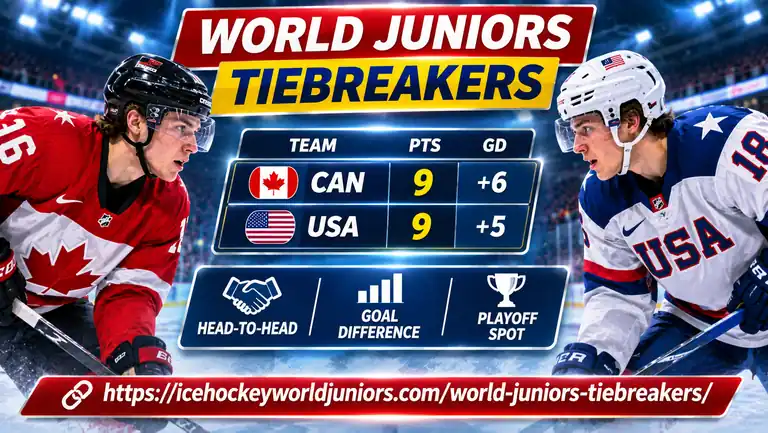
World Juniors tiebreakers decide final standings when teams end the group stage level on points. This guide explains each rule with a simple example, the quarterfinal pairing, and how the semifinals are set.
| Detail | Facts |
|---|---|
| Two teams tied | Head-to-head game decides |
| Three or more teams tied | Sub-group of the tied teams |
| Games not all played | Fewest games played first |
| Quarterfinal pairs | A1 v B4, A2 v B3, B1 v A4, B2 v A3 |
| Semifinals | Quarterfinal winners are reseeded |
| Quarterfinal losers | Ranked 5th to 8th by group position, then preliminary-round record (points, goal difference, goals scored) |
| Playoff dates | Jan 2 quarterfinals, Jan 4 semifinals |
| Last Update | Nov 19, 2026 |
How Group Rankings Work
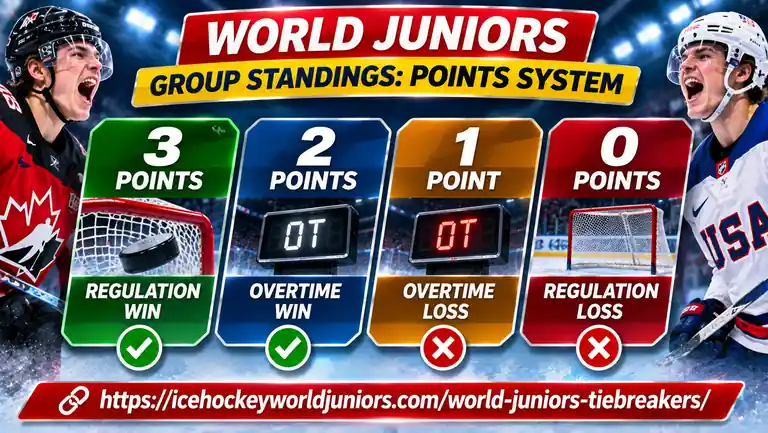
Each team plays every other team once in its group. Regulation wins earn three points, overtime wins two, overtime losses one, and regulation losses none. The top four teams in each group reach the quarterfinals, as our rules page explains.
How Tiebreakers Work
When two or more teams finish with the same points, then IIHF applies the tiebreaker rules. The method depends on how many teams are tied, and it starts with their own games. Two teams use that one game, and three or more teams use a mini table.
Two Teams Tied
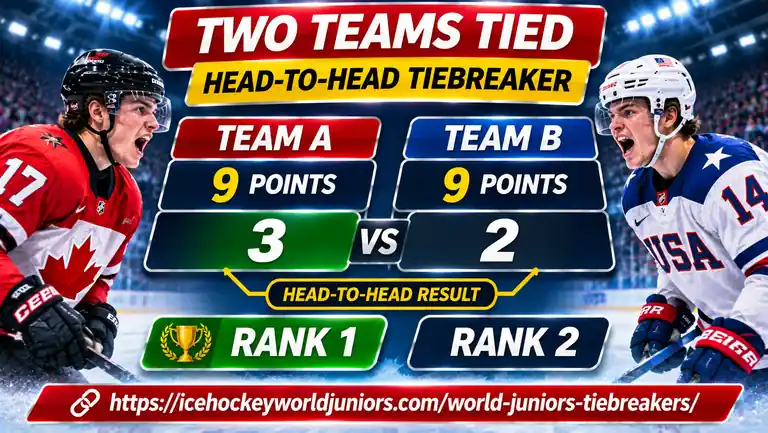
When two teams finish level on points, their head-to-head game decides the ranking. The winning team ranks higher. Goal difference does not matter here, even if the losing team has better overall numbers.
Three or More Teams Tied
When three or more teams finish level, the IIHF uses only their head-to-head results. Those results form a mini table, which is ranked using the steps below. The process repeats until two teams remain tied, and the game between them decides their order.
When Teams Have Not Played Each Other
Some ties must be settled before the group stage ends, when not all tied teams have met. The same rule applies to two teams that have not yet played each other. The criteria below apply in order, and the first one that separates the teams decides.
Tiebreaker Examples
Example 1: Two Teams Level on Points
After four games, Team A and Team B finish the group stage with nine points each. Team A beat Team B 3-2 when they met, so Team A ranks higher. Team B ranks lower, even though both teams finished with the same number of points.
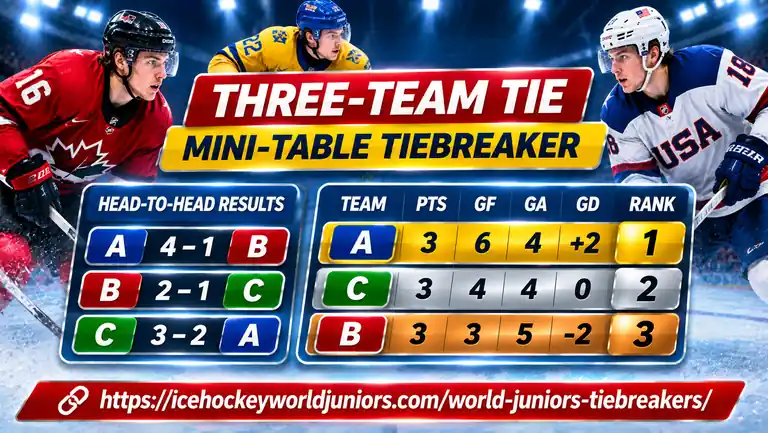
Example 2: Three Teams Level on Points (goal difference step)
Teams A, B, and C all finish the group tied at seven points each. Each team won one game and lost one game against the other two. That leaves all three level on mini-table points, so goal difference decides next.
| Game | Result |
|---|---|
| A v B | A wins 4-1 |
| B v C | B wins 2-1 |
| C v A | C wins 3-2 |
| Team | Mini-table points | Goals for | Goals against | Goal difference | Rank |
|---|---|---|---|---|---|
| A | 3 | 6 | 4 | +2 | 1 |
| C | 3 | 4 | 4 | 0 | 2 |
| B | 3 | 3 | 5 | -2 | 3 |
Example 3: A Tie Before All Games Are Played
Team A and Team B are tied on six points midway through the group stage. Team A has played three games so far, while Team B has played only two. Team B ranks higher here because it earned the same six points in fewer games.
How the Quarterfinals Are Set
The top four teams in each group reach the quarterfinals on January 2. Pairs cross between the groups, so no team meets a group rival in the quarterfinals. Group winners face the fourth-place teams from the other group, and second-place teams face third-place teams.
| Pairing | Who plays |
|---|---|
| A1 v B4 | Group A winner v Group B fourth place |
| A2 v B3 | Group A second place v Group B third place |
| B1 v A4 | Group B winner v Group A fourth place |
| B2 v A3 | Group B second place v Group A third place |
How the Semifinals Are Set
The four quarterfinal winners are reseeded for the semifinals based on their group-stage results. The best-ranked semifinalist faces the lowest-ranked semifinalist, while the second-best faces the third-best. No team keeps its quarterfinal pairing, so the semifinal matchups are set only after January 2.
Semifinal Reseeding Example
Here is a made-up example with four quarterfinal winners and their group records. Group position comes first, so points only separate teams that finished in the same spot. The table below shows the final ranking and the resulting semifinal pairs.
| Team | Group position | Group points | Reseed rank | Semifinal opponent |
|---|---|---|---|---|
| W | 1st | 12 | 1 | Rank 4 (Z) |
| X | 2nd | 9 | 2 | Rank 3 (Y) |
| Y | 2nd | 8 | 3 | Rank 2 (X) |
| Z | 3rd | 6 | 4 | Rank 1 (W) |
How Quarterfinal Losers Are Ranked
The four quarterfinal losers finish fifth to eighth in the final tournament ranking. They rank first by group position, then by group-stage points, goal difference, and goals scored. The quarterfinal score does not change that ranking order.
Conclusion
Points decide the group order at the 2027 World Junior Championship, and tied teams are split by head-to-head or the sub-group formula. Two teams use their head-to-head game, while three or more teams use a mini table. Group position sets each quarterfinal pairing, and the quarterfinal winners are reseeded for the semifinals. Follow the live standings to see every position change as the games are played out.