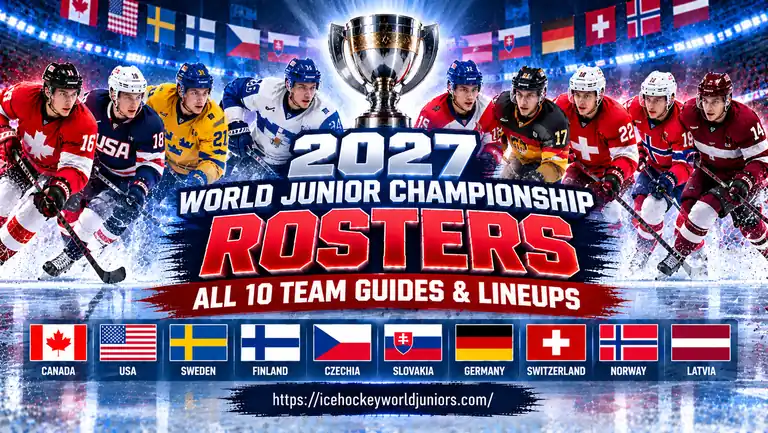

IIHF World Junior Championship 2027 Rules & Format: The Complete Guide
Every WJ game follows a clear structure that determines how teams compete, score points, manage roster limits, handle overtime formats, and advance through the tournament. This World Junior Championship 2027 Rules & Format guide explains the complete rules and format.
| Detail | Info |
|---|---|
| Total Teams | 10 |
| Groups | 2 (A & B) |
| Players per Team | 25 |
| Age Limit | Under Twenty |
| Game Length | 3 periods, each has twenty minutes |
| Win Points Scenario | 3 (regulation), 2 (overtime/shootout) |
| Points for a Loss | 0 (regulation), 1 (overtime/shootout) |
| Teams that Advance | Top 4 teams from each group |
| Last-place Fate | Relegation game |
Tournament Overview
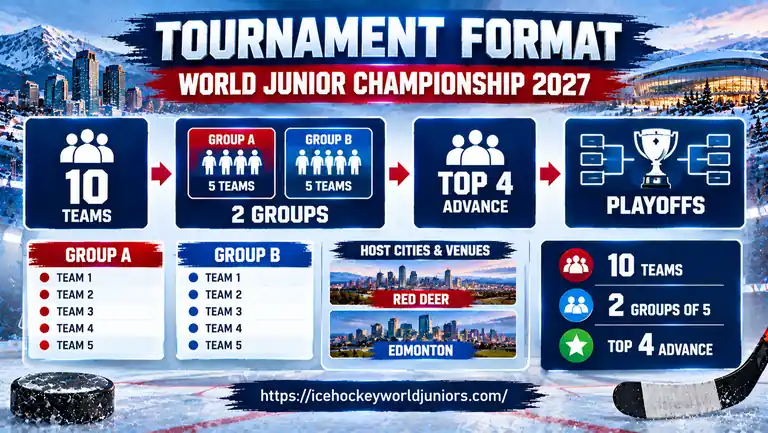
Ten nations participate in this tournament. They are divided into two groups; each has five teams. Group A will play its preliminary games in Red Deer. Group B will play in Edmonton. Each team plays once against every other team in its group. The top four teams advance to the playoff round.
Game format and match duration
Each game has three periods. Each period continues twenty minutes. Teams switch arena sides after each period. Workers fix the ice in between periods. If a game ends in a tie, extra rules decide the winner.
Roster Rules & Player Eligibility
Every player must be under twenty years old in this tournament. A player cannot have turned 20 before December 31, 2026. Each team brings 22 skaters and 3 goalies. That makes 25 players on every roster.
Standings and Points System

Teams earn points based on how the match ends. Teams earn 3 points for a regular-time win, and 2 points for an overtime or shootout win. A loss in overtime or a shootout earns 1 point, and a loss in regular time earns 0 points. These points decide the team’s group standings.
Tie-Breaking Rules
Sometimes both teams’ games finish with the same number of points. In this case, these rules decide the winner.
How teams qualify for playoffs
Each group has five teams. The top four teams in each group advance to the playoff stage. The fifth-place team in each group plays a special game.
How Quarterfinal matchups are decided
Once the top teams are determined in each group, they get matched up. The matchups follow a fixed pattern based on final group rank:
Knockout Stage Explanation
The tournament moves into Knockout games after the group stage. Eight teams play four games in the quarterfinals. The four winners of the quarterfinals move forward to two semifinal games. Semifinal winners play for the gold medal, and losers play each other for bronze.
Overtime and shootout rules
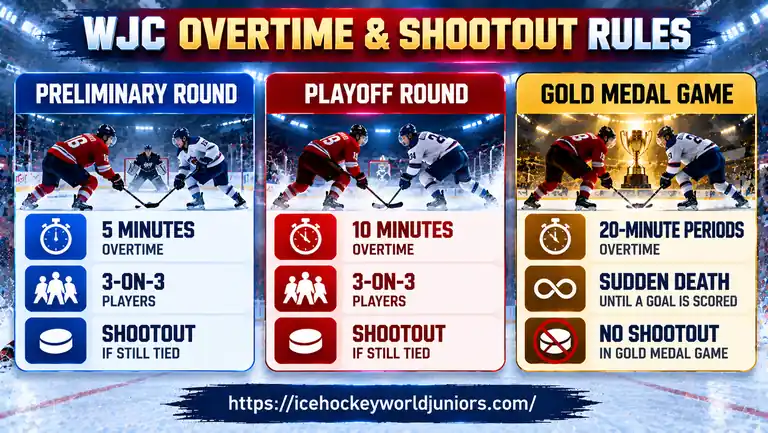
Not every game ends after three periods. When a game is tied, extra time or a shootout decides the winner. Rules can change slightly depending on which round is being played.
Overtime and shootout rules
PRELIMINARY ROUND
If a group stage match ends in a tie, the teams play a five-minute overtime period with three skaters and a goaltender per side. If no goal is scored, a shootout decides the match, with five players from each team taking turns.
PLAYOFF ROUND
Tied playoff games get ten minutes of three-on-three extra time. If the score is still tied, the game moves to a shootout. This applies to quarterfinals, semifinals, and the bronze medal game.
GOLD MEDAL GAME
The gold medal game never ends in a shootout. If the score is tied, teams play full 20-minute overtime periods until a team finally scores. Whoever scores first in overtime wins gold.
Relegation & Promotion rule
The relegation game decides which team is relegated from the top division. The fifth-placed teams from Groups A & B play against each other. The losing team moves down to the lower division next year. The winning team maintains its position in the top division for the next event.
What is the difference between WJC and NHL Rules?
| Rule | WJC | NHL |
|---|---|---|
| Points System | 3-2-1-0 scale | 2 points for any win |
| Overtime (group stage) | 5 min, 3-on-3 + shootout | 5 min, 3-on-3 + shootout |
| Overtime (playoffs) | 10 min, 3-on-3, then shootout | 20 min, 5-on-5, no shootout |
| Final (gold medal) | Continuous 20-min overtime, no shootout | Continuous overtime, no shootout |
| Rink Dimensions | NHL size (for tournaments in Canada) | NHL regulation dimensions |
| Tournament Format | Group stage + playoff stage | Regular season + playoffs |
| Relegation | Last-place team may be relegated | No relegation system |
Complete Tournament Flow
Ten teams play in two groups of five.
Points decide each team’s final group rank.
Top four teams in each group advance.
Fifth-place teams play for survival.
Eight teams play four single-elimination games.
Four winners play two single-elimination games.
Bronze game and gold game close out the event.
Conclusion
This tournament follows a structured format from the group stage to the gold medal game. Ten teams compete in the group stage, then advance to the knockout stages. From the points system and tie-breaking criteria to overtime rules and relegation, every detail helps determine the outcome. Understanding these rules makes each game easier to follow and more enjoyable.