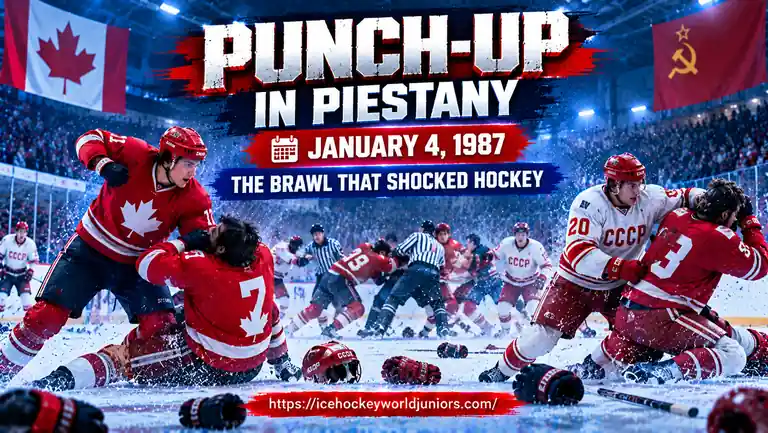
Punch-Up in Piestany: What Happened in the 1987 World Juniors Brawl
The Punch-Up in Piestany was a brawl between Canada and the Soviet Union during a junior hockey game on January 4, 1987. Canada led 4-2 when both sides’ benches were empty, and the arena lights went out. The IIHF expelled both teams from the World Juniors and erased the game from the record books.
| Detail | Info |
|---|---|
| Date | Jan 4, 1987 |
| Event | IIHF 1987 WJC |
| Venue | Zimný štadión Piešťany (now Slovakia) |
| Teams | Canada vs Soviet Union |
| Score at Brawl | Canada 4 – Soviet Union 2 |
| Brawl Length | Approx. 20 minutes |
| Referee | Hans Rønning (Norway) |
| Result | Game declared null and void; both teams expelled |
| 1987 Medalists | Finland (gold), Czechoslovakia (silver), Sweden (bronze) |
This Guide covers what happened, who was punished, and how the fight changed the tournament.
Why the Game Mattered
Czechoslovakia 10, and Canada nine. Team Canada already held a guaranteed bronze medal even if it lost this final game.
The Soviet team had a 2-3-1 record and was already out of medal contention. Soviet players had already lost any chance at a medal before the opening faceoff that night.
What Happened on the Ice
Tension was high because Canada and the United States brawled in warm-ups three days earlier. After that fight, referee Hans Rønning randomly ejected one player from each team. Despite his limited experience at that level, Rønning then took charge of Canada against the Soviets.
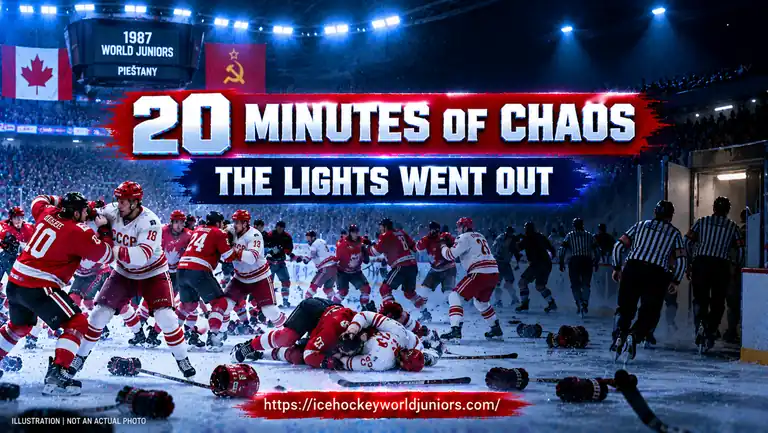
Vladimir Konstantinov head-butted Canadian defenseman Greg Hawgood and broke his nose during the chaos. Two Soviet players also beat Canadian forward Stéphane Roy while teammates fought elsewhere on the ice. The brawl then lasted about 20 minutes before the IIHF declared the game null and void.
The IIHF Decision
IIHF directors held an emergency meeting in an arena office after the brawl ended, and it lasted about 35 minutes. Each team had one delegate, and IIHF President Günther Sabetzki led the meeting. The delegates voted to expel both teams, and only Canada’s Dennis McDonald voted no.
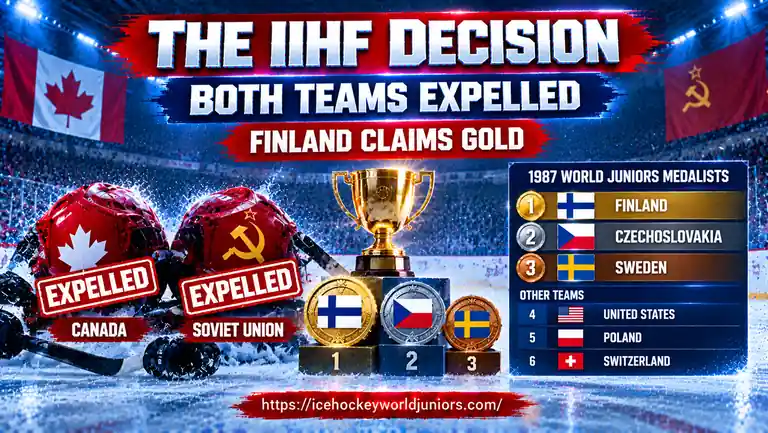
The IIHF voided the final standings for both Canada and the Soviet Union. Other teams kept the points they had earned in games against those two teams. Finland then won its first World Junior gold, while Czechoslovakia took silver and Sweden took bronze.
| Rank | Team | Record | Points |
|---|---|---|---|
| 1 | Finland | 5-1-1 | 11 |
| 2 | Czechoslovakia | 5-2-0 | 10 |
| 3 | Sweden | 4-2-1 | 9 |
| 4 | United States | 4-3-0 | 8 |
| 5 | Poland | 1-6-0 | 2 |
| 6 | Switzerland | 0-7-0 | 0 |
See every champion on our past winners page.
Punishments and Suspensions
The IIHF also suspends every player involved in a fight from international hockey for 18 months. They banned coaches for three years. Player suspensions later dropped to six months on appeal. That change let many players from both sides return for the 1988 Moscow tournament.
| Who | Outcome |
|---|---|
| Canada and the Soviet Union | Expelled from the tournament, with standings voided |
| Players involved | 18-month ban, cut to six months on appeal |
| Coaches | Three-year ban |
| Soviet head coach Vladimir Vasiliev | Fired as the junior team coach |
| Referee Hans Rønning | Never officiated another international game |
| Goalie Jimmy Waite and forward Pierre Turgeon | The only two Canadians not suspended |
| Both teams in 1988 | The IIHF considered a B pool move or a ban, then dropped the idea |
Who Was to Blame?
Both sides blamed each other for the brawl, and their accounts never matched. A Soviet official said a Canadian trainer attacked a Soviet assistant coach on the bench. Canadians said Evgeny Davydov left the Soviet bench first and sparked the brawl.
Much of the blame also fell on referee Hans Rønning, who lacked experience at that level. Both teams committed several stick fouls that went uncalled, and tempers kept rising throughout the game. The IIHF chose him for his neutrality, not his international record.
Some Canadian voices accused the Soviets of starting the fight on purpose. Broadcaster Don Cherry argued the Soviets wanted Canada ejected so it would lose a medal. Alan Eagleson said the IIHF would have ruled differently if the Soviets still chased a medal.
Myths and Facts
| Myth | Fact |
|---|---|
| It was the gold medal game | It was the last round-robin game. Finland v Czechoslovakia, played earlier that day, decided gold |
| Canada lost the game | The IIHF declared the game null and void, so it had no final result |
| Only Canada was punished | Both teams were expelled, and players and coaches on both sides were suspended |
| Canada lost a sure gold | Sportsnet says Canada needed only a clear win for gold, while other accounts say only a five-goal win would have done it. The expulsion cost it the bronze it had already clinched |
Reaction in Canada and Lasting Impact
The CBC analyst Don Cherry showed the game live, and many Canadians backed the players afterward. Polls reported that between 87 and 92 percent of respondents supported the team’s actions. Maple Leafs owner Harold Ballard even had special gold medals made for the Canadian players.
Canadian hockey officials reacted more coldly and criticized the players for the brawl. Reporters at the time said the Canadian Amateur Hockey Association gave the players little support afterward. Don Cherry defended the team strongly, and his popularity with Canadian fans rose sharply.
The brawl also changed how much attention Canadian media gave the World Juniors. One Canadian reporter traveled to the 1987 event, but every major outlet sent staff in 1988. By 2005, more than 100 Canadian reporters covered the tournament in Grand Forks, North Dakota.
Players on the Ice
Many players from this game went on to long NHL careers. Nineteen of the 20 Canadians who dressed that night later played in the NHL. Four players from the game, two from each team, later joined the Hockey Hall of Fame.
| Player | Team | Note |
|---|---|---|
| Theoren Fleury | Canada | Scored the first goal and later played over 1,000 NHL games |
| Brendan Shanahan | Canada | Hockey Hall of Fame member |
| Pierre Turgeon | Canada | Hockey Hall of Fame member and one of two Canadians not suspended |
| Greg Hawgood | Canada | Suffered a broken nose in the fight |
| Sergei Fedorov | Soviet Union | Hockey Hall of Fame member |
| Alexander Mogilny | Soviet Union | Hockey Hall of Fame member |
| Vladimir Konstantinov | Soviet Union | Head-butted Hawgood during the brawl |
1988: Canada and the Soviet Union Return
Both teams returned to Moscow, the Soviet capital, for the 1988 World Juniors. Canada won its third World Junior gold, and the Soviet Union took silver. Several players from the 1987 game, including Alexander Mogilny and Greg Hawgood, also played in Moscow.
40 Years Later: January 4, 2027
The brawl turns 40 years old on January 4, 2027, the day of the semifinals. Rogers Place in Edmonton will host both semifinals at 3:30 PM and 7:30 PM Mountain Time. Russia’s status is disputed after the October 30, 2026 CAS ruling, so whether Canada can meet its old Soviet rival in Edmonton depends on the final field, which has not been announced yet.
| Game | Mountain Time | Eastern Time |
|---|---|---|
| Semifinal 1 | 3:30 PM | 5:30 PM |
| Semifinal 2 | 7:30 PM | 9:30 PM |
See all times on our schedule and game times pages.
Conclusion
The Punch-Up in Piestany ended in chaos and cost Canada a medal. The IIHF expelled both teams, and Finland won its first World Junior gold. The fight also raised the tournament’s profile in Canada, and its 40th anniversary is on January 4.