
World Junior Championship History: The Complete Story (1977-2026)
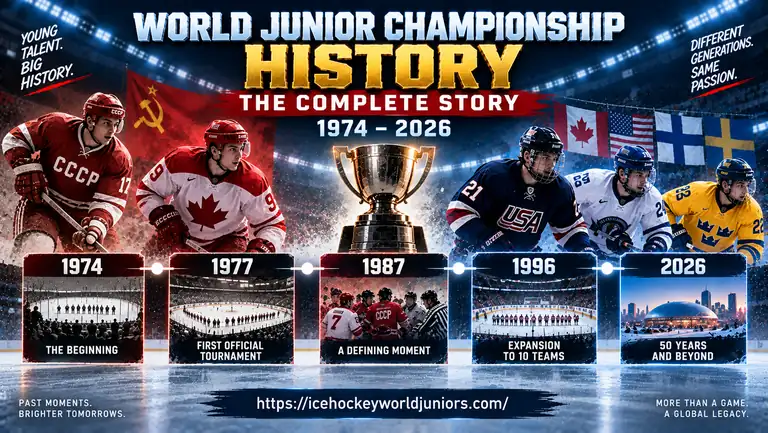
The World Junior Championship started unofficially in 1974. It was officially launched in 1977 and has produced legendary moments, dominant eras, and unforgettable rivalries since. The event grew from a small invitational event in the mid-1970s into one of the most anticipated tournaments in global hockey.
| Description | Info |
|---|---|
| First Unofficial Tournaments | 1974, 1975 & 1976 |
| First Official Tournament | 1977 |
| Original Tournament Format | 8 Teams & Round Robin |
| Expansion to 10 Teams | 1996 |
| Total Official Editions | 50 |
This World Junior Championship History guide breaks down the tournament’s entire history from its origin to the present day.
The Unofficial Years (1974-1976)
Three tournaments took place before the official recognition in 1977. The Soviet Union won all three unofficial championships. Although these competitions showcased strong young talent, they lacked the structure of later tournaments. Today, the IIHF does not include these early editions in its official records.
The First Official Tournament in 1977
The International Ice Hockey Federation held the first official World Junior Championship in 1977. Two cities of Czechoslovakia (Zvolen and Banská Bystrica) hosted the inaugural tournament. Eight teams competed in a round-robin format, and the Soviet Union won gold.
Soviet Union Dominance 1977-1980
The Soviet Union won gold medals in the first four official tournaments, from 1977 to 1980. Their youth program reflected Soviet hockey’s global dominance during the Cold War era. Western nations, including Canada , initially struggled to match the early Soviet development system. This period of dominance established the tournament’s first individual dynasty.
Canada & Russian Brawl of Piestany in 1987
The punch-up in Piestany on January 4, 1987, is the most infamous international brawl between Canada and the Soviet Union. The bench-clearing fight lasted about twenty minutes. Officials turned off the arena lights after unsuccessfully trying to stop the fight. Both teams were expelled from the tournament.
Expansion to Ten Teams
The tournament expanded from eight to ten participating teams in the 1996 edition. Organisers divided the ten nations into two preliminary groups of five teams. This tournament ended the original round-robin format. This structural change created the modern group-stage system still used in tournaments today.
The Modern Era: Global Growth & Rising Competition
The tournament’s profile grew significantly in Canada during the 1990s and 2000s. Television coverage expanded greatly, turning the event into a must-watch annual holiday tradition. Young stars like Sidney Crosby and Connor McDavid rose to prominence through this tournament. Today, NHL scouts, fans, and teams closely monitor every game.
The Rise of New Contenders (2000 – 2020)
The 2000s brought a clear turning point, as new contenders began to challenge the dominance of the traditional powers. Teams such as the United States, Finland, and Sweden regularly reached the medal rounds. Their success narrowed the gap at the top and made the tournament far more competitive at every stage.
50-Year Milestone of WJC
The 2026 tournament in Minneapolis marked the championship’s official 50th anniversary. Former players, including brothers who competed decades apart, reflected on the tournament’s remarkable growth. Sweden’s gold medal added a memorable chapter to this landmark anniversary season.
How History Connects to the 2026-2027 Edition
The 2026-27 tournament in Edmonton and Red Deer continues a five-decade-old tradition. Canada will host this edition, a nation deeply tied to the championship’s growth and popularity. The ten-team format, introduced in 1996 and divided into two groups, remains unchanged.
Conclusion
In conclusion, the tournament’s fifty-year journey has turned it from an invitational event into a world-class spectacle. What began with three unofficial games now captivates hockey fans worldwide. The events in Piešťany, Soviet dominance, and Canadian pride have all shaped this remarkable half-century journey.